Are there American-trained doctors in Chapala and Ajijic, Mexico?
Thomas Hellyer - Chapala Home Sales
Most of the doctors in Chapala and Ajijic did most of their training in Guadalajara, which is about 45 minutes away, and there are some American doctors here who have had training and worked in the States, but in order to practice here they have to have a Mexican degree. They have to do an internship here; otherwise, they cannot legally practice here in Mexico.
Most Mexican doctors go to the States periodically for ongoing training. The medical schools in Guadalajara teach in...
Most of the doctors in Chapala and Ajijic did most of their training in Guadalajara, which is about 45 minutes away, and there are some American doctors here who have had training and worked in the States, but in order to practice here they have to have a Mexican degree. They have to do an internship here; otherwise, they cannot legally practice here in Mexico.
Most Mexican doctors go to the States periodically for ongoing training. The medical schools in Guadalajara teach in English because that is the language used to explain the most up to date information.
All the doctors who speak English go to Houston or to California for their ongoing education, which most of them do on a regular basis, especially the ones who are working here with foreigners. There is one doctor in particular, Doctor Santiago, who is from Chicago, but did his medical education in Jalisco. Then he went back to the States and practiced medicine for a number of years and decided to relocate down here in Chapala. So he is an American who speaks both Spanish and English and who got his medical degree in Jalisco, so he is a legal doctor in Mexico. He is also a legal doctor in the States. There are a number of doctors who have the skills of Doctor Santiago who are practicing here in Chapala.
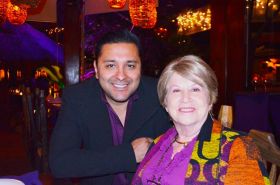
(American- trained doctor, Dr. Santiago Hernandez at the MEXPAT mixer, Chapala Mexico, pictured.)
What's the crime rate in general in Ambergris Caye?
Christian Burn
Belize City is not a safe place. I would not recommend spending time in the city, but once you are in the island of Ambergris Caye, yes, you are safe. All of the islands of Belize are safe to the extent that you do not leave yourself wide open.
You don't leave your Nikon camera on your golf cart seat and walk away because it’s not going to be there in half an hour (and it wouldn’t be there in Canada, either). You should not leave your Samsung smart...
Belize City is not a safe place. I would not recommend spending time in the city, but once you are in the island of Ambergris Caye, yes, you are safe. All of the islands of Belize are safe to the extent that you do not leave yourself wide open.
You don't leave your Nikon camera on your golf cart seat and walk away because it’s not going to be there in half an hour (and it wouldn’t be there in Canada, either). You should not leave your Samsung smart phone down on your towel, go for a swim, and expect it to be there. You might be able to do that in a resort compound with full staff and security, but most likely, there is a chance it might not be safe either because everybody passes through the beach. People need to be smart. They need to travel with sense above them, and if they do that, they will generally be fine.
Can I use my Medicare outside the US, and if not, what are my alternatives?
By Edgington
The short answer is no, you cannot use Medicare here in Colombia. The long answer is beyond the scope of a response. International health care policies are a good option, but, as always, the fine print is your friend. For instance, many international policies will not insure you within a certain number of miles of your 'home address,' so don't let that codicil bite you. In our case, with a home address (for now) in Ohio, we can't use our policy within 100 miles of Columbus, so we...
The short answer is no, you cannot use Medicare here in Colombia. The long answer is beyond the scope of a response. International health care policies are a good option, but, as always, the fine print is your friend. For instance, many international policies will not insure you within a certain number of miles of your 'home address,' so don't let that codicil bite you. In our case, with a home address (for now) in Ohio, we can't use our policy within 100 miles of Columbus, so we must acquire an additional policy within that range (I know, it's nuts) or risk going uninsured.
The really good news about all this is that many health care systems abroad are much, much cheaper than that found in the U.S., for example, while retaining the quality found there--or exceeding it. My wife needed a full panel dental x-ray when we arrived in Medellin, and she received it in one hour, with no appointment, for about $6.00 US. (You read that right, no need to wipe your glasses.) No co-pay. No insurance interaction.
So one answer to the question is to acquire emergency or major medical coverage only, and pay out of pocket for the rest. Not exactly an answer to the original question about Medicare use, but an elaboration on options. Another item to consider is Tricare, if the retiree is eligible for military retirement bennies. Tricare can be used (I'm told) by paying for the expenses, then submitting paperwork to Tricare for reimbursement. Disclosure: I've not gone this route. I've only been told it's possible, so good luck.
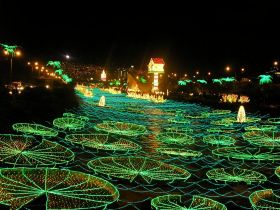
(Photo: Medellin River, Christmas 2004. Credit: By Aliman5040 - taken by Alejandra Zapata (my cousin), CC BY-SA 3.0, Wikipedia.)
How bad are the mosquitoes and other bugs and insects in Panama?
Lourdes Townshend
Mosquitos and other bugs (like chitras), are common in some areas of the city, especially in Costa del Este, El Valle or areas surrounded by vegetation, like Gamboa, or the "interior", pass by the Bridge of the Americas, like, but not limited to Howard.
The best month to avoid the interior is May, as that's when the rains begin. But this problem is no more or less than every city around the world. The jungles are different. For example,...
Mosquitos and other bugs (like chitras), are common in some areas of the city, especially in Costa del Este, El Valle or areas surrounded by vegetation, like Gamboa, or the "interior", pass by the Bridge of the Americas, like, but not limited to Howard.
The best month to avoid the interior is May, as that's when the rains begin. But this problem is no more or less than every city around the world. The jungles are different. For example, a very bad place for bugs is the jungle in Darien.
The economy of the Algarve is mainly focused on tourism, which is the main economic driver here. There is a little bit of agriculture in particular with the production of local fruits such as oranges, carobs, almonds, etc. There is some fishing, including offshore aquaculture or what we call “long line fishing,” cultivation of oysters, mussels, etc. There is also some tuna aquaculture in the Rio de Tavira. There is no manufacturing industry here but there is a little bit...
The economy of the Algarve is mainly focused on tourism, which is the main economic driver here. There is a little bit of agriculture in particular with the production of local fruits such as oranges, carobs, almonds, etc. There is some fishing, including offshore aquaculture or what we call “long line fishing,” cultivation of oysters, mussels, etc. There is also some tuna aquaculture in the Rio de Tavira. There is no manufacturing industry here but there is a little bit of the service industry.
Then of course, there is the public sector. There are a lot of public sector employees who work in the municipalities, tax department, and public services in general. Generally, tourism and the public sector and a little of agriculture are the economic drivers of the Algarve.
The economy right now is better than it had been 9 years ago. Tourism has been growing year after year. Tourism here includes the activities related to expats and anything else that involves people visiting the region or ultimately moving here, typically not full time initially but part time until they understand whether this is the place for them or not, and then becoming permanent residents. That transition phase is something that is included in the tourism numbers.
In the World Travel Market in London, the Algarve is again the Most Requested Region in the World. Tour operators in the UK are moving a lot of the traffic from North Africa and the Middle East to southern European places like the Algarve, which has been particularly popular. From the tourism, sector, the Algarve is doing very well and this has been boosted by the new legislation called the Non-Habitual Residency, which means that people can come and live and even retire in Portugal tax free. This has increased the demand for the country of Portugal and specifically for the Algarve.
(Olive you, Portugal. I love you, Portugal graphic by Jet Metier, pictured.)
How's the standard of living in Managua, Nicaragua?
Mike Quinn - Farmstay El Portón Verde
The standard of living in Managua, Nicaragua for an expat is very good. That said, adjusting to the extreme poverty, the heat, and some of the customs here can be a challenge. But on a purely cost of living basis, Managua is one of the best options for someone looking to live well on a limited budget. According to the cost of living comparison website, numbeo.com, Managua has an average monthly cost of living of $2,246.97 in Managua to maintain the same standard of life that you...
The standard of living in Managua, Nicaragua for an expat is very good. That said, adjusting to the extreme poverty, the heat, and some of the customs here can be a challenge. But on a purely cost of living basis, Managua is one of the best options for someone looking to live well on a limited budget. According to the cost of living comparison website, numbeo.com, Managua has an average monthly cost of living of $2,246.97 in Managua to maintain the same standard of life that you can have with $3,200.00 in Panama City.
But cost alone does not include everything to consider in a discussion of standard of living. Managua offers a unique situation where, as the capital city, the biggest in Nicaragua, it has the most opportunities for diversion, entertainment, arts, sports, culture, dining, and shopping then anywhere else in Nicaragua. If you want to enjoy a lifestyle where almost everything is easily available at a good price, where a wide variety of activities can be enjoyed, and be able to afford to do it, Managua is a good option.
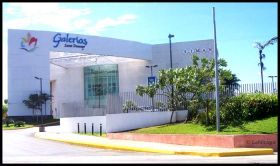
For example, on Tuesdays movie tickets are half-price at the upscale shopping mall close to my Farmstay. Galerias de Santo Domingo also has a great sushi restaurant where during the weekdays, sushi rolls are 2 for 1. A wonderful daytime date with your sweetheart can be had for under $20! That is a great bargain, right?
Of course, if you are looking to lighten the housekeeping load, domestic employees are available for about $200 per month.
A driver can be hired for approximately $10 per hour if you do not want to drive or take local transportation.
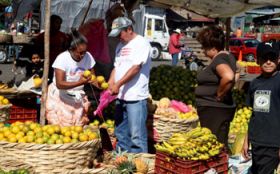
The amount and variety of fresh fruit and vegetables is amazing in Managua. Going to the wholesale fruit and vegetable market on an early morning sojourn can be an exhilarating experience, not to mention tasty!
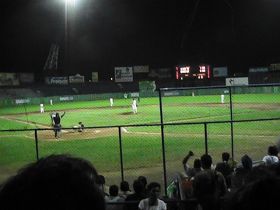
Another example of a great deal that shows what a nice lifestyle can be had in Managua is when I had guests who wanted to go to a baseball game to see the Managua Boers professional team at the national baseball stadium. When we arrived, the game had already started, but no worries, we got a great parking spot, and found out they had a great promotion that night. VIP seating, promotional dancing girls, and three Flor de Caña rum cocktails for 100 cordobas, or approximately $4 USD!
Thanks for reading and I hope this helped answer your questions about the standard of living in Managua, Nicaragua.
Homesickness hits us all here in Panama. Of course, any place you move to outside the US you will find the same thing.
For me it took about three months to hit. You’re so busy doing this and that to prepare for your leaving the US and so happy about your new life that awaits you. When you get here, you have shopping to do, moving into your new home, people to meet and greet. You’re happy with all the new things to see and do around you; the music the food,...
Casco Viejo, or “the Old City of Panama” is the historic city center of Panama. It is a peaceful and charming district of narrow streets, accompanied by balconies full of the flowers of two and three-story houses. At its end is the French Park, a monument to the French builders who began construction of the Panama Canal, and the beautiful French Embassy, pictured here.
On the boulevard around the monument, visitors have a good view of Mirador Amador and the Bridge of the...
Sometimes when you read about a country, many times you only find the "tourist" attractions. But I want to introduce a little bit of history about Panamá that is not mentioned in many books or tour guides.
Recently, in a popular newspaper in Panamá, the "La Estrella de Panamá" there was an article about a very particular history that was, until now, little known, but nonetheless, is a magnificent piece of a glorious past.



 Most of the doctors in Chapala and Ajijic did most of their training in Guadalajara, which is about 45 minutes away, and there are some American doctors here who have had training and worked in the States, but in order to practice here they have to have a Mexican degree. They have to do an internship here; otherwise, they cannot legally practice here in Mexico.
 The short answer is no, you cannot use Medicare here in Colombia. The long answer is beyond the scope of a response. International health care policies are a good option, but, as always, the fine print is your friend. For instance, many international policies will not insure you within a certain number of miles of your 'home address,' so don't let that codicil bite you. In our case, with a home address (for now) in Ohio, we can't use our policy within 100 miles of Columbus, so we...
 The economy of the Algarve is mainly focused on tourism, which is the main economic driver here. There is a little bit of agriculture in particular with the production of local fruits such as oranges, carobs, almonds, etc. There is some fishing, including offshore aquaculture or what we call “long line fishing,” cultivation of oysters, mussels, etc. There is also some tuna aquaculture in the Rio de Tavira. There is no manufacturing industry here but there is a little bit...
.jpg) is the historic city center of Panama. It is a peaceful and charming district of narrow streets, accompanied by balconies full of the flowers of two and three-story houses. At its end is the French Park, a monument to the French builders who began construction of the Panama Canal, and the beautiful French Embassy, pictured here.
is the historic city center of Panama. It is a peaceful and charming district of narrow streets, accompanied by balconies full of the flowers of two and three-story houses. At its end is the French Park, a monument to the French builders who began construction of the Panama Canal, and the beautiful French Embassy, pictured here.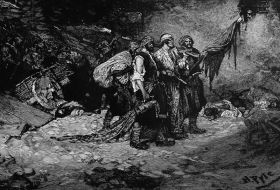 Sometimes when you read about a country, many times you only find the "tourist" attractions. But I want to introduce a little bit of history about Panamá that is not mentioned in many books or tour guides.